
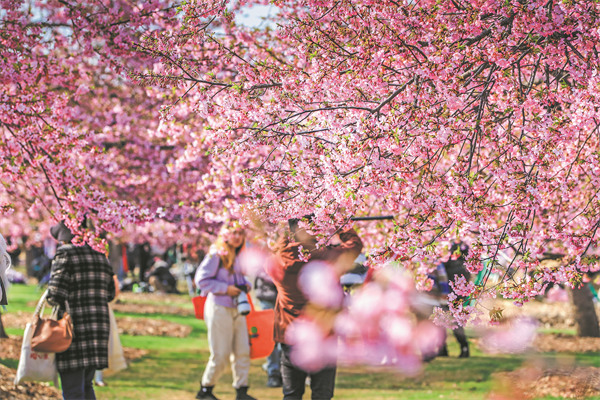
Under radiant petals and moonlit groves, residents welcome a vibrant season as new cherry tree varieties paint the cityscape in blush, reports He Qi.
At Shanghai's Gucun Park, visitors in flowing hanfu pause beneath the cherry blossoms, capturing the essence of spring as pink and white flowers sway gently in the breeze, signaling that the annual cherry blossom season is in full swing in the city.
Across Shanghai, the blooms are beginning to unfold. From new nighttime viewing experiences at Gucun Park in Baoshan district to breakthroughs in domestic cherry tree breeding at Chenshan Botanical Garden, the coming weeks promise a colorful spring landscape, offering residents a romantic spring escape.
As a central part of the city's spring cultural tourism, the 2026 Shanghai Cherry Blossom Festival runs from Monday to April 9 at Gucun Park, which spans over 1,600 mu (106.7 hectares), with 120 varieties and more than 16,000 cherry trees, making it the city's largest and most popular cherry blossom destination.
This year, in addition to adding popular varieties like the white Somei Yoshino and the pink Kawazu-zakura cherry, the festival goes beyond traditional flower viewing, emphasizing all-day experiences and cross-disciplinary integration. One highlight is the nighttime "Moving with the Blossoms" model, which encourages visitors to enjoy the trees after sunset.
"In the past, time constraints limited cherry blossom viewing, and office workers often missed the daytime bloom because there were few good options at night," explains Liu Chuanbao, general manager of Shanghai Wusongkou Culture Tourism Investment (Group) Co. "This new model follows the natural rhythm of the flowers and offers a more enriching experience."
During the initial blooming phase from March 9 to 21, the area near Gate 3 of Gucun Park remains open until 9:30 PM. From March 21 to April 9, when flowers reach mid and late bloom, the central area near Gate 2 will feature light installations, cultural markets, and specialty food stalls.
"The extended hours aim to create an immersive nighttime experience while boosting the city's growing night economy," adds Liu.
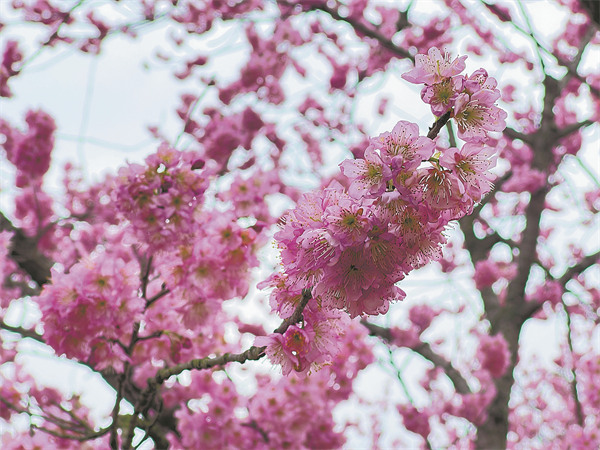
Currently, the early-blooming cherries are in full bloom. Li Yong, the park's vegetation management supervisor, explains: "The main varieties in full bloom now are Prunus introrsa or Chunhan, Kawazu-zakura, and Prunus campanulata Maxim cherry. The differences are quite distinct: Prunus campanulata Maxim has a purple tone, with bell-shaped flowers hanging downward, hence its name; Kawazu-zakura is pink and vibrant; Chunhan has particularly lush stamens."
Li also revealed key updates on the blooming schedule. "The two most anticipated varieties, Prunus campanulata or Feihan and Somei Yoshino, are expected to enter their display period in about two weeks, with their peak bloom in late March and early April, coinciding with the Qingming Festival, when the city will see a peak in cherry blossom viewing."
Beyond flower management and variety cultivation, Gucun Park is also improving visitor services and cultural tourism integration. An enhanced cherry blossom passport is being introduced, integrating resources from Baoshan's commercial zones, dining, accommodation, and cruise services.
Visitors who purchase festival tickets or participate in associated events can receive discounts and free parking. The park is also introducing accessible viewing services, including free electric vehicle transfers and wheelchair assistance for visitors with lower limb disabilities.
Behind the vibrant urban cherry blossom landscape lies a groundbreaking breakthrough in domestic cherry tree breeding, according to Yu Lixia, chief engineer of the horticultural landscape department at Chenshan Botanical Garden.
"By 2020, only 21 locally bred cherry blossom varieties were authorized. Between 2021 and 2025, that number grew to more than 200," says Yu.
Chenshan Botanical Garden has introduced nearly 30 indigenous and nationally bred varieties. These represent more than 30 percent of the total, with high-quality domestic varieties like the Feihan cherry being gradually used in urban landscaping, effectively breaking the monopoly of foreign cherry blossom varieties.
The garden is helping develop "technical guidelines for planting and maintaining cherry trees in urban green spaces," addressing persistent gaps in local landscaping standards, ensuring vibrant flowers and stable blooming periods.
Weather patterns have also influenced this year's blooming in Shanghai. A relatively warm winter and intermittent high temperatures accelerated the blooming of some varieties. The Kawazu-zakura trees at Chenshan Botanical Garden entered full bloom nearly 10 days earlier than in 2025, the earliest peak in nearly five years.
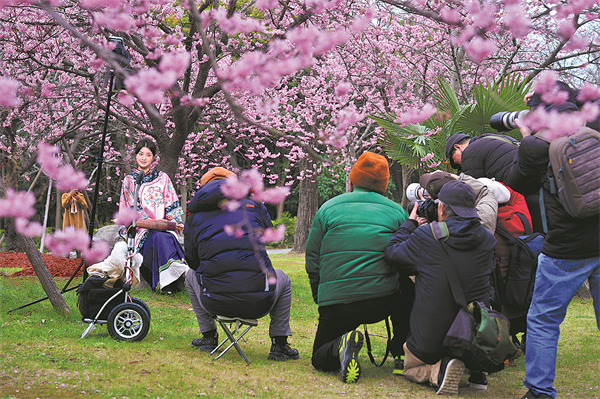
Yu says the early blooming offers both pleasure and scientific value, enriching residents' spring experiences and providing valuable field data for tracking plant phenology in cities.
Shanghai's cherry blossom viewing map has long achieved multi-point blooming, greatly improving viewing convenience. In addition to the main landmark spots of Gucun Park and Chenshan Botanical Garden, Lu Xun Park, Jing'an Sculpture Park, Gongqing Forest Park, and Century Park are excellent options for residents to enjoy the blossoms.
"Cherry blossoms also brighten neighborhood streets and smaller community green spaces. The succession of early, mid, and late-blooming varieties allows people to enjoy flowers from late February through April, extending the romance of spring throughout the city," adds Yu.