
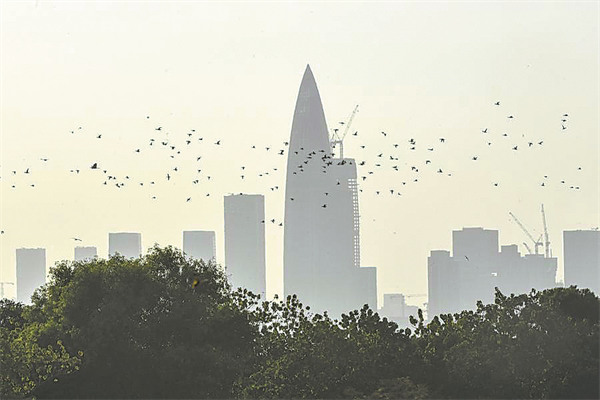
In Shenzhen, Guangdong province, southern China, known for its technological development and dazzling modernity, a recent dispute over park lighting attracted great attention, and the winner was wildlife.
A Shenzhen resident posted a message on an online city forum to express concern about the lighting along the paths of a popular bayside park. The resident felt these paths were too dark at night and suggested installing more streetlights for both safety and aesthetic reasons.
However, the city's park management center rejected the request. It stated that adding brighter lights would have a negative impact on migratory birds that use the wetland as an essential stop along the East Asian-Australasian flyway. Notably, bright lights can disorient birds during their nocturnal migrations and disturb their winter roosting.
The center also noted that basic lighting remains at main entrances and intersections to meet visitors' essential needs for safe passage.
This official response did not provoke further public complaints. Instead, it was met with a wave of praise on social media in March.
"Shenzhen is friendly to small animals. This is genuine urban warmth," wrote a WeChat user. Another commented: "Let the birds rest at night. After all, we all share the same planet."
There are more than 450 species of wild birds in the city, representing one-third of the total wild bird species in China, according to the latest survey by Shenzhen's ecological environment department.
Cai Xiao, a birdwatcher from Shanghai, eastern China, gives a thumbs up to Shenzhen, noting that the recent lighting issue there highlighted social progress, as both residents and municipal authorities were aware of this risk and willing to address it.
"Compared to the past, when the focus was solely on increasing illumination to attract visitors, this represents a significant shift. For bird enthusiasts like us, it's truly encouraging," adds Cai.
In recent years, this innovation hub of southern China has begun to reinvent itself with numerous efforts focused on biodiversity-inclusive designs.
A notable example is Binhai coastal avenue, where residents and environmental protection volunteers observed that the intense glare of streetlights startled the flocks passing by. Local policy advisors, along with several government departments, soon worked on the problem and spent two months modifying the lamps to find a balance, making them bright enough for drivers and dim enough for birds.
Beyond lighting, Shenzhen has added patterned stickers to tall glass buildings to prevent bird collisions and has published official guidelines requiring more bird-friendly urban planning and designs.
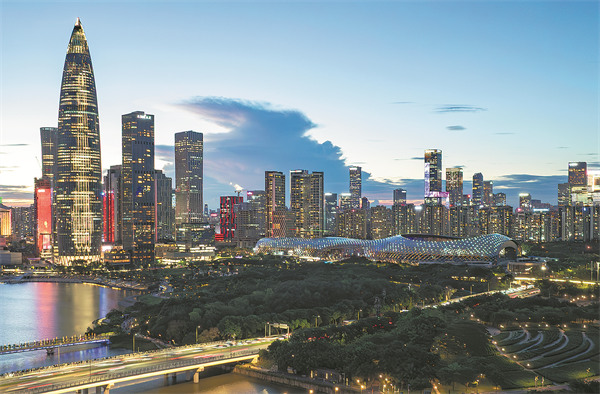
The most striking symbol of this philosophy is Bridge No. 1 of the Kunpeng Trail, which connects two mountains separated by highway construction. To provide a migratory passage for wild animals, Shenzhen built a pedestrian bridge. Only one-tenth of the bridge platform is paved for human use. The rest is left for small animals such as leopard cats and wild boars, featuring many plants that create a forest-like environment.
In 2024, weeks after opening the bridge, infrared cameras captured a leopard cat crossing it.
"The bridge has reserved ample space for wildlife habitat and migration, creating a 'dual corridor' where humans and wildlife coexist harmoniously without disturbing each other," says Nan Zhaoxu, a Shenzhen-based scholar who studies the city's nature and history.
Last year, two more bridges of this type were opened for animal migration.
Many of Shenzhen's approaches have been replicated by other Chinese cities, which are incorporating biodiversity protection into their urban planning. No longer pursuing economic growth at the expense of the environment, they are discovering that more wildlife is returning to enjoy urban life.
Social media comments sum up this progress: "This is the attitude a civilized city should have."